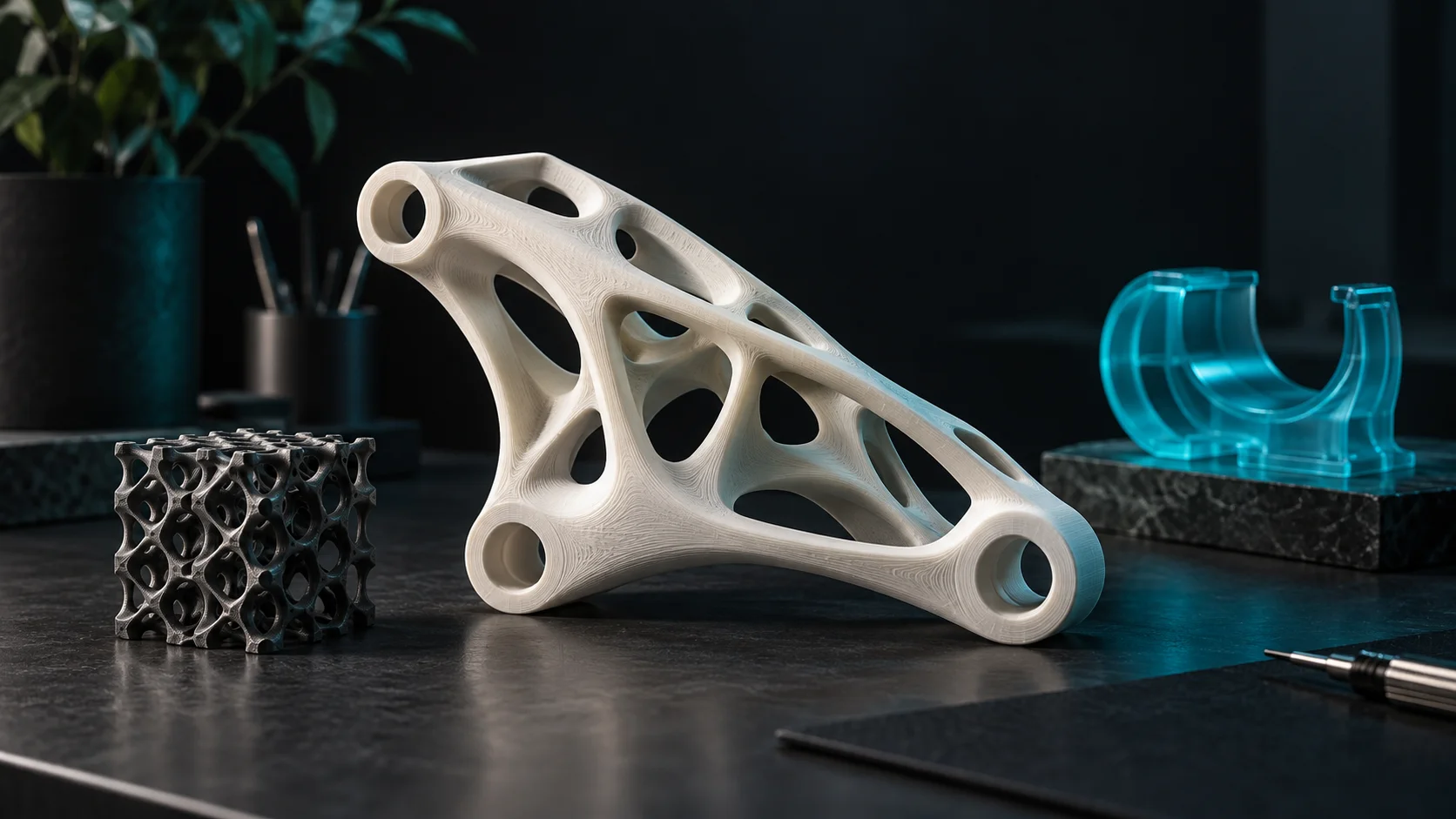
Its applications range from batch production, prototypes and replacement parts to healthcare, architecture, fashion, design and everyday household objects.
The history of 3D printing
3D printing was originally associated with “rapid prototyping”, the quick production of prototypes. This allowed companies to start projects with lower costs and make changes simply by editing the digital design.
As mentioned above, one of the pioneers was Charles
W. Hull, who later founded 3D Systems and produced physical objects from digital 3D data.
Later, Adrian Bowyer launched the RepRap project at the University of Bath, aiming to develop a printer capable of making as many of its own components as possible. As an open-source project, it invited contributions from a worldwide community. RepRap helped make 3D printing more accessible and influenced many subsequent desktop printers.
Applications of 3D printing
Affordable printers brought 3D printing to large and small businesses for production and prototyping, as well as to designers, makers and hobbyists.
Its appeal also lies in the freedom to create a wide range of objects from individual digital designs.
Batch production
3D printing offers a flexible approach to producing repeated parts and product batches.
Replacement parts
Whether restoring a classic car or repairing an appliance, 3D printing can offer a solution for suitable components. A part can be drawn in 3D software or scanned, adapted and printed.
Making unavailable components
When a part is no longer available, 3D printing may provide a way to redesign and reproduce it.
Architecture and construction
3D visualisation is an important part of architectural projects. Where designs were once viewed only on a screen, 3D printing now makes it possible to create physical architectural models that communicate proposed buildings more directly.
Custom production
There is considerable room for creativity, within the requirements of the manufacturing process. Digital models are easy to edit, allowing each object’s parameters to be tailored. The range of printing materials also offers a broad choice of colours and textures.
3D printing in healthcare
Specialist 3D printing is used for implants, medical devices and prosthetics. Dental applications include dentures, crowns and orthodontic appliances.
Other uses include jewellery, either printed directly or made using printed casting patterns; fashion prototypes and garment components; automotive parts; and interior design, from prototypes to individual furniture elements.
Technology
3D printing makes it possible to create objects ranging from complex prototypes to functional parts and production batches. It builds objects layer by layer, with the process varying according to the material and technology. Choosing the right material and manufacturing method is therefore essential. Three common approaches are outlined below.
1. Filament is extruded by the print head through a heated nozzle. This is the principle behind FDM (fused deposition modelling) and FFF (fused filament fabrication). The terms describe the same basic process; FDM is a registered trademark of Stratasys.
2. Liquid resin is cured in selected areas of each layer using light. Examples include stereolithography (SLA), with related processes using a UV laser or a DLP projector.
3. Fine powder is joined using a laser. Selective laser sintering (SLS) is an example of this approach.
FDM/FFF
FDM describes a process in which filament is melted in the print head and deposited layer by layer onto a build plate.
FFF describes the same basic process. The alternative term is used because FDM is a Stratasys trademark.
SLA — stereolithography
Stereolithography builds objects by curing liquid photopolymer with light. Layers are formed and cured in succession until the object matches the digital design.
SLS / DMLS
These processes use a laser to join powder particles. SLS commonly uses polymers such as polyamide, while related metal processes, including DMLS, work with metal powders.
Materials
Choosing a suitable material is essential for every print. The following are among the materials we use.
PLA
PLA, or polylactic acid, is a thermoplastic polyester. One advantage is its renewable origin, rather than dependence on petroleum. Its appearance is similar to conventional durable plastics, with mechanical properties that include stiffness, hardness and resistance to deformation.
NYLON
Nylon is a familiar synthetic material, particularly from the textile industry. Its distinctive properties also make it useful in 3D printing.
NYLON CARBON
This filament combines nylon with a high proportion of carbon fibres to create a reinforced material with improved stiffness and thermal performance.
It can provide good dimensional accuracy and surface quality in printing.
PET-G
PET-G is derived from PET, a widely used plastic found in bottles, food packaging and textile fibres. The “G” refers to glycol modification.
A tough material suited to more demanding handling and elevated temperatures within its specified limits.
It has a glossy finish and good layer adhesion. Recycling depends on suitable local facilities.
PC — polycarbonate
A tough thermoplastic with high impact resistance. Despite its strength and rigidity, it is relatively lightweight and also offers electrical insulating properties.
TPU
Thermoplastic polyurethane is known for its flexibility and chemical resistance.
TPE
TPE combines softness and flexibility with durability.
ABS
ABS stands for acrylonitrile butadiene styrene, an amorphous thermoplastic copolymer known for its toughness and resistance to mechanical damage.
ASA
ASA is similar to ABS but tends to shrink less during printing and offers good UV resistance. It is suited to outdoor applications, sports equipment and furniture, with resistance to impact and wear.
TPS
Styrene-based thermoplastic elastomers are a widely used group of TPE materials, offering flexibility and useful mechanical properties.
PP — polypropylene
A durable material offering several post-processing options. It can be welded, bent and machined, although bonding with adhesives can be difficult. Outdoor suitability depends on the grade and additives.