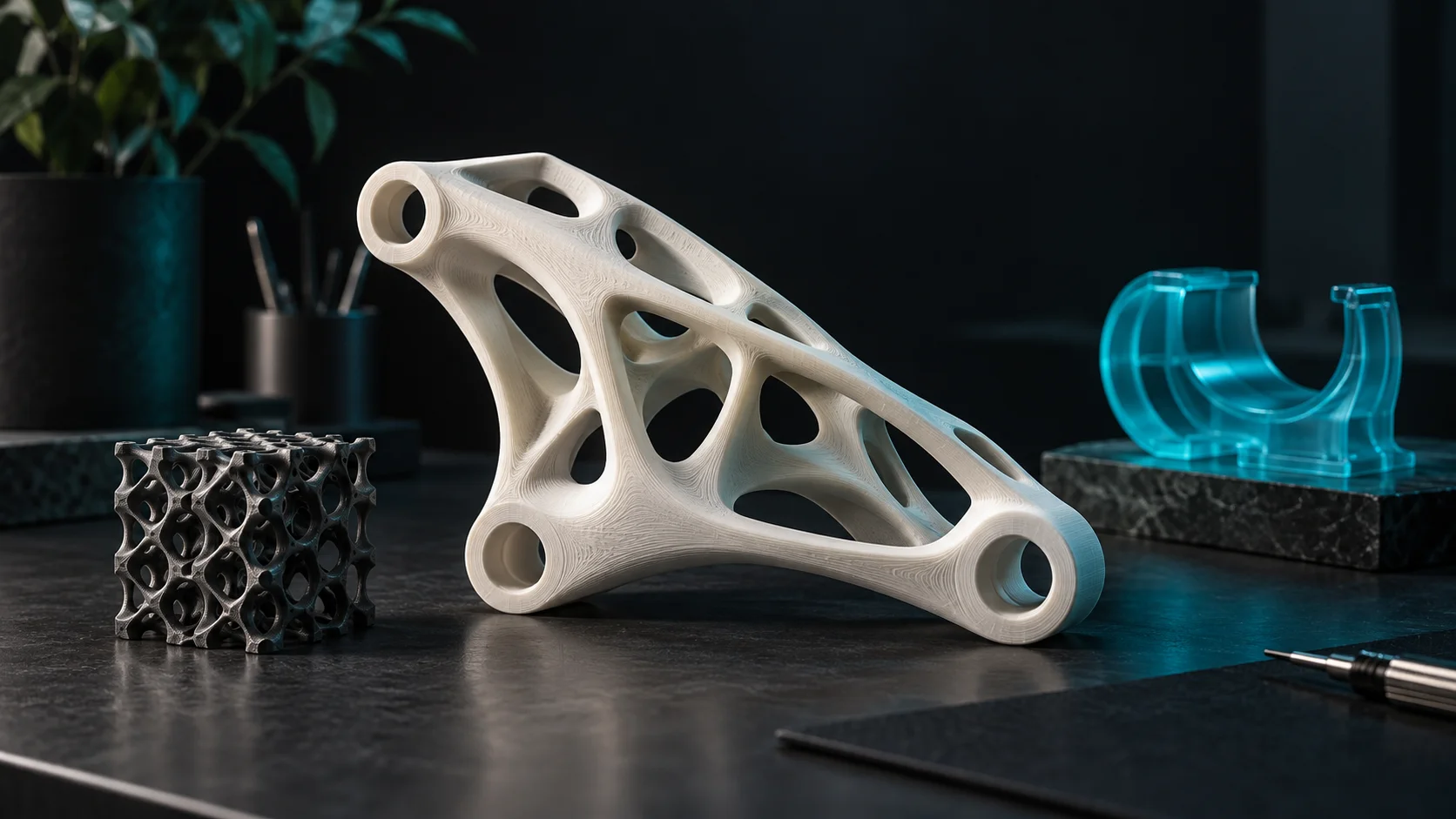
The properties of a filament depend on its composition.
Before printing, it is important to consider the object’s intended use and choose a suitable filament. This article provides an overview of commonly used materials and their properties.
An overview of 3D printing materials
PLA
PLA, or polylactic acid, is a thermoplastic polyester. One advantage is its renewable origin, rather than dependence on petroleum. Its appearance is similar to conventional durable plastics, with mechanical properties that include stiffness, hardness and resistance to deformation.
Properties: Hardness, low warping and low thermal expansion.
Applications: Prototypes and toys, as well as larger objects and small components.
PET-G
PET-G is derived from PET, a widely used plastic found in bottles, food packaging and textile fibres. The “G” refers to glycol modification.
It is a tough material suited to more demanding handling. It has a glossy surface, bonds well between printed layers and can be recycled where suitable facilities are available.
Properties: Heat resistance, toughness, gloss, good layer adhesion and low odour; recycling depends on local facilities.
Applications: Suitable for mechanically stressed components.
ASA
ASA is similar to ABS but tends to shrink less during printing and offers good UV resistance. It is suited to outdoor applications, sports equipment and furniture, with resistance to impact and wear.
Properties: UV and heat resistance, with good adhesion between printed layers.
Applications: Suitable for outdoor objects and models that require post-processing.
ABS+
ABS+ is a modified form of ABS designed to improve performance, including heat and wear resistance.
Properties: Durability and reduced printing deformation; exact strength and temperature performance depend on the particular formulation.
Applications: Everyday objects exposed to greater mechanical stress.
ABS
ABS stands for acrylonitrile butadiene styrene, an amorphous thermoplastic copolymer. It is a tough, rigid material known for resistance to mechanical damage. Depending on its grade, it withstands a range of temperatures and chemicals. Suitable bonding methods include specialist solvent-based or acrylic adhesives.
It is used in products such as furniture components and is the material used for most LEGO bricks.
Properties: Rigidity and resistance to temperature changes and certain chemicals, depending on the grade.
Applications: Practical objects, prototypes and tools.
NYLON
Nylon is a familiar synthetic material, particularly from the textile industry. Its distinctive properties also make it useful in 3D printing.
Its strengths include toughness, durability, elasticity, chemical resistance and low weight. Temperature and moisture behaviour depend on the particular grade.
Properties: Strength, flexibility, elasticity, chemical resistance and low weight.
Applications: Spare parts and mechanically stressed components.
NYLON CARBON
This filament combines nylon with a high proportion of carbon fibres to create a reinforced material with improved stiffness and thermal performance.
It can provide good dimensional accuracy and surface quality in printing.
Properties: Chemical and heat resistance, with good surface quality.
Applications: Suitable for stressed components and automotive or motorcycle parts where the selected grade meets the requirements.
TPU
Thermoplastic polyurethane is known for its flexibility and chemical resistance.
Properties: Flexibility and chemical resistance.
Applications: Applications include healthcare, automotive parts and accessories for electronics, such as cases and protective covers.
TPE
TPE combines softness and flexibility with durability.
Properties: Resistance to abrasion, bending and tearing.
Applications: A wide range of objects requiring high flexibility.
TPS
Styrene-based thermoplastic elastomers are a widely used group of TPE materials, offering flexibility and useful mechanical properties.
Properties: Chemical resistance and flexibility.
Applications: Used across industries for its elastic properties.
PC — polycarbonate
A tough thermoplastic with high impact resistance. Despite its strength and rigidity, it is relatively lightweight and also offers electrical insulating properties.
Properties: Durability, low weight and electrical insulation.
Applications: A wide range of durable parts and components.
PP — polypropylene
A durable material offering several post-processing options. It can be welded, bent and machined, although bonding with adhesives can be difficult. Outdoor suitability depends on the grade and additives.
Its solvent resistance changes at elevated temperatures, including in contact with xylene or tetralin around 160–170 °C.
Properties: Durability and options for post-processing.
Applications: Used in the chemical, textile and food industries.